• BU Home | 
  • News | 
  • Events | 
  •  | 
  •  

Volume 58 / Number 1

Seed of Hope

by student journalists Tina Garee, Cory Streeter, Tom Sveen, Doug Ekbom, Travis Grabow, and Lucas Spaeth

Alumna Breaks New Ground in Opening Access to Faith-Based Counseling

Lori* clung to the hope.

She was losing a battle to depression and alcoholism as a young adult. I hated being in my own skin, she recalls. But deep down, even in the suffering, Lori still felt that a piece of herself—just the size of a mustard seed—was protected by God. Pure. Precious.

A seed of hope.

deb

Bethel Graduate School  alumna Deb Lindell, M.A., LMFT, founder and president of Seed of Hope

guy


photo by Scott Streble

Tom Bursheld, M.A., LMFT, is one of 100 counselors who have helped Seed of Hope clients so far. About 95 percent of the therapists are Christian

After joining Alcoholics Anonymous, Lori sought professional help and found Debra Lindell, a Christian therapist trained in the M.A. in Counseling Psychology program at Bethel University.

Counseling brought clarity. And it saved my life, Lori says. To finally talk it out and understand she was worth something—that she was loved by God—was instrumental in her recovery.

Only through counseling, she reflects, were we digging down to that seed of hope.

Barriers for Many

"For most people, there's a natural process of healing that medical physicians can help on a physical level, and trained mental health professionals can help on a psychological level," says Myrna Seibold, Ph.D., director of Bethel's graduate program in counseling psychology, and the governor's appointed chair of the Minnesota Board of Psychology.

"It seems to me that God has decided, for whatever reason, to work through relationships," she adds, "and a counseling relationship is one of [them]."

Even with strides in treatment, obstacles remain. Research shows mental health problems growing at an alarming rate—particularly among young people, war veterans, and disaster victims. Many insurance plans still exclude or greatly limit coverage for mental health services, according to a landmark study by the Department of Health and Human Services titled Mental Health: A Report of the Surgeon General.

"Even more than other areas of medicine, the mental health field is plagued by disparities in the availability of and access to its services," writes David Satcher, M.D., in the report. "The country isn't stepping up to the plate to deal with its mental health needs."

Even when people do have benefits, many are limited to a "provider network" that restricts their choice of counselor. That fact creates another significant barrier as people are insecure about finding a therapist they can trust—one, for example, who shares their religious views.

The Seed is Planted

Lori was fortunate. She was able to get help from a Christian therapist, and she had adequate coverage.

Thankful for that, she knew what to do with an unexpected $1,500 refund that her insurance company wouldn't take back. She donated the money to her counselor, Deb Lindell, to start a program that would help others.

Today, Lindell is president of Seed of Hope, an organization dedicated to making skilled, competent counseling affordable for individuals and families in need. Seed of Hope not only funds counseling visits for people who have no insurance coverage; it helps people of any faith find a counselor who holds similar spiritual views. "Who wants to open their life up to someone they don't trust, someone who doesn't share their values?" asks Lindell, who aims to restore choice as well as access to the treatment system.

Since its founding in 2000, Seed of Hope has blossomed with a growing list of charitable donors and volunteer therapists. To date, it has aided more than 300 patients with affordable, private counseling.

The process is simple. A client needing care selects the therapist he or she prefers. That therapist applies to Seed of Hope and, if approved, is given a single grant of $500 toward professional counseling sessions. The counselor agrees to lower rates by an average of 40 percent for Seed of Hope clients, a discount that enables about 12 sessions for each patient.

People in desperate situations get help. A single mother in college had a restraining order against her ex-husband and desperately needed counseling for herself and her five-year-old son, according to Katherine Haskin, the therapist who counseled her with aid from Seed of Hope. With very little income and no child support, the woman filled out the application, and within two weeks therapy was making a huge difference in her life. "I can't ever imagine not using [Seed of Hope] again for similar situations," Haskin says.

"Good Samaritan" Philosophy

Lindell has networked extensively to tap Seed of Hope board members from major companies, including Honeywell, Cherry Tree, and Cummins. Bethel Psychology Professor Jim Koch, Ph.D., is also a board member.

Funding for Seed of Hope services comes from major philanthropic organizations—the Park Nicollet Foundation and the Oswald Foundation—and many individual donors as well. Tom Oswald says, "Seed of Hope is a small step toward reaching those in need of that kind of help."

Park Nicollet's Medical Director Chris Johnson says he loves what the organization is doing. "When we see a person in need," he says, "we don't see a Christian, a Jew, or a Muslim; we just see a person in need."

What Johnson refers to is a unique aspect of the charity. Seed of Hope is a Christian foundation that makes no attempts at evangelism. Volunteer therapists and clients represent a range of religious faiths, although Lindell estimates that 95 percent of the therapists who have served Seed of Hope clients to this point have been Christian.

"You don't have to believe like we do in order for us to care for who you are," says Lindell, who wants Seed of Hope to model the Good Samaritan of the Gospels. That in itself, she said, has been a powerful witness. "I have never been more evangelistic in my life than since I decided to stop trying to being an evangelist," she adds.

The issue of religious affiliation was a huge hurdle when Seed of Hope first started. "First we thought, ‘we'll only fund Christian therapists,' says Lindell. "Then we thought, ‘what Christian therapists should we fund? Do they have to be Baptist? Sign a statement of faith?' Then I just had a message from the Lord—I really believe this was the Holy Spirit—‘Debbie, just cast your bread upon the water, and trust me to return it. Trust [me] to use it and to work with it.'"

A Journey to Bethel

The only one of five siblings to finish college, Lindell attributes her

Helping Fellow Veterans

graduation


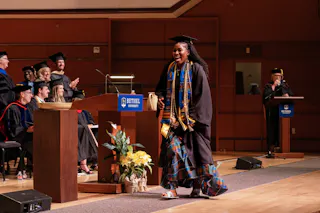
Lancaster with Bethel professor Joel Fredrickson at graduation

Steven Lancaster earned his master's in counseling psychology at Bethel in 2005 after his education was interrupted by a two-year tour of duty in Iraq with the National Guard. Lancaster is now working on his Ph.D. in clinical psychology at Southern Illinois University, where he is studying the effects of traumatic events and post-traumatic stress disorder (PTSD). "In Iraq…I could see the danger of it all. I had near-death incidents happen to friends, and I could see the mental change in them," explains Lancaster. "We all have human, temporal needs as well as spiri0tual needs."

This emphasis on the whole person underlies Bethel's approach to psychology. Students are given the opportunity to apply Christian worldviews to the highest professional standards and practices in the field.

giving spirit to growing up poor. "Freely you've received, freely you give," is her philosophy.

Sipping a cup of tea in her office, she reflects on her eclectic life: between high school and college, she had a strong conversion experience, went through a phase as a hippie, joined a Christian commune whose goal was inner healing, lived on a kibbutz in Israel, and taught school in Fargo and Minneapolis.

Eight years after graduating from the University of Minnesota with a psychology major, Lindell decided to become a practicing therapist, and chose Bethel's graduate program in counseling psychology.

Myrna Seibold, her academic advisor, saw the makings of Seed of Hope in her student long ago. "It was clear that Deb was an initiator and an innovative thinker—and a person of deep Christian commitment," she remarks. Those who knew Lindell at Bethel are not surprised that now, as a practitioner, Lindell has seen an unmet need in the world of mental health, made the necessary funding connections, and counted on God to do the rest.

"Jesus talked about how a mustard seed grows into this big thing," Seibold says. "That was His analogy for the kingdom of God, and we've seen a parallel with Seed of Hope."

For more information on Seed of Hope, visit www.seedofhope.org.

* Lori is an assumed name to protect confidentiality.

advanced group

Contributing student journalism team (left to right): Tina Garee; Cory Streeter, editor; Tom Sveen; and Travis Grabow. (Not pictured: Lucas Spaeth)