Bethel Focus
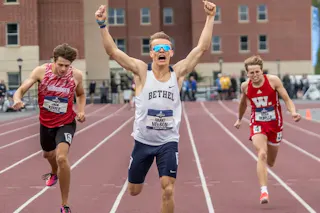
If you look for both thrill and purpose in athletics, look no further than Bethel University. In just the past decade, Bethel has become a top multi-sport contender in the 13-school Minnesota Intercollegiate Athletic Conference (MIAC), one of the toughest Division III conferences in the nation.
More than 450 Bethel University students participate in 17 varsity sports. Next year, the addition of women’s golf will make it 18—nine for women and nine for men.
Extraordinary performance has attracted a new level of visibility for Bethel athletics, with major area media regularly covering Bethel athletes, coaches, and teams. And the notoriety has helped tell the kingdom story that is tightly woven into the entire athletic endeavor at Bethel University.
“Wins show Bethel is not some isolated Bible college,” says Judy Moseman, recently retired vice president for student life, who spent 26 years at Bethel building a strong athletics program. “The successes have allowed the story to be told to a larger audience.”
Moseman is gratified by the success of another historic effort she nurtured while at Bethel: parity in programs. In Fall 2008, the addition of women’s golf will give BU an equal number of women’s and men’s sports—nine apiece, for a total of 18.
Why the healthy growth in Bethel athletics, paying off in recent statistics and public recognition? Athletics staff say the phenomenon is composed of a number of strands, some old, some new:
All these factors are now paying off in visible ways.
No two Bethel coaches recruit the same way, but networking with high school coaches and assistants has stepped up, and interest is increasing from student athletes themselves. A majority of Bethel’s programs use web-based recruiting software to streamline and simplify the process. Technology gives part-time assistant coaches the ability to help the head coach by tracking and following up with prospective student-athletes in the recruitment pipeline.
“In contrast to a shotgun approach, we take a rifle approach to recruiting these days,” says Steve Johnson, head football coach since 1989. He and his coaching colleagues say they’re looking for the right kind of student who will fit into the team and benefit from the Bethel experience. “They gotta be good,” said Johnson, “but we also check out the heart.”
Men’s Hockey and Golf Coach Joel Johnson agrees that just being an accomplished player doesn’t guarantee a spot on the team: “The type of kid we look for has more to do with off-ice character than on-ice talent,” he says.
Where does Bethel find this kind of talent and heart—especially since NCAA Division III rules prohibit athletic scholarships? Freshman star running back Logan Flannery from Lakeville, Minn., may best illustrate the answer. Although his dad urged him to check out Bethel because of its spiritual emphasis and respected football coach, “I kind of wanted a bigger atmosphere,” he told the Pioneer Press newspaper in an interview. “[But] after giving [Bethel] a chance and getting to know the coach and people...it was a lot different. Coach J is amazing. He has a different relationship than a lot of coaches do with their players.”
“One of the goals we have is to get the prospective students on campus and show them around to help them get a sense of what Bethel is like on the inside,” says Steve Johnson. “Then they can decide for themselves whether it’s a good fit.” Recruiting also improves with a growing reputation, adds Johnson. “It’s easier to talk with prospective students when we’re more successful.”
Once students find themselves at Bethel, Johnson has a way of reassuring them about the game itself.
“Because people think right away that Christians are soft,” Johnson observes, “we feel we’re called to be the most physical team in the league.” When he tells this to the Royals first thing every year, he says their eyes light up because the guys really want to play football—very much a contact sport.
Next, Johnson talks about horses. Horses that work hard—dependable, sleek, powerful, and full of integrity. Anybody can be [that other word for a mule], Johnson tells his team. “But being a horse, that’s something to shoot for.”
Working that philosophy into victories has a lot to do with common, everyday denial of self. Grueling drills and exhausting repetition of the fundamentals achieve a small miracle: a tough team that springs from a group of individuals. Teams often have two hours of practice time set aside on a daily basis, but to stay competitive, training outside of practice is expected, too. Bethel has a strength and conditioning coach who works with teams to develop off-season and in-season training programs that help athletes get in shape and stay healthy during their season.
On top of physical workouts, there is study of the game. Coaches often call their players together to analyze game videos to understand and improve individual and team performances in preparation for the next game.
Tough training is a valuable metaphor for the Christian life, Royals coaches believe. The men’s hockey team chose Hebrews 12:11 as its theme verse this year. “No discipline seems pleasant at the time, but painful. Later on, however, it produces a harvest of righteousness and peace for those who have been trained by it.”
Since 1996, Bethel has introduced several new game and workout facilities, and has made major improvements to older ones, including the weight room.
“I feel like 1996 was the year that we really started to ‘get good’ and a lot of that had to do with finally having a facility we could be proud to call home,” says Johnson. The football team has since posted an overall record of 96-32—a .750 winning percentage and a 50-10 record at home.
In 2000, the Bethel baseball team began play on its new facility, Hargis Park. That same year, the team earned its first MIAC playoff berth. “It was great to finally have an on-campus field,” says Bethel Sports Information Director and Assistant Baseball Coach Dale Eng ’00, who was a Bethel student on that team. “It was pretty humbling to have to practice on little league fields, and then to be kicked off those fields by the little leaguers because they took precedence.”
Soon thereafter, construction began on the Ona Orth Athletic Complex to support the soccer, softball, and tennis programs. The complex opened in the fall of 2003 and one year later, the men’s soccer team earned a trip to the MIAC playoffs.
Just last winter, Minnesota Governor Tim Pawlenty was on hand to cut the ribbon at the Bethel University Arena at the Schwan’s Super Rink—part of the National Sports Center in Blaine, Minn., and home to the men’s and women’s hockey programs. The men’s team posted a 9-0 record in the new facility on their way to the NCAA Playoffs, where they reached the second round.
“We still need to put good athletes on the field to be competitive,” said Bjorklund, “but it certainly helps from a recruiting standpoint to be able to show prospective students that we’ve got a place for them to develop as players.”
In addition to the new facilities, the Sports and Recreation Center (SRC) got a major facelift before the 2006-07 school year to include a new running surface and a paint job. As a result, the SRC last February hosted its first indoor track meet since 2002, and looks to host more track and field events in the future.
Strong leadership has also reinvigorated Bethel’s athletics
program.
Within the last three years, seven new head coaches have
been hired, along with a new athletic director, Bob Bjorklund, who
moved up from head men’s basketball coach.
Staffing decisions are made with a great deal of deliberation. The best candidates are carefully screened by a diverse group, including the vice president for student life, the athletic director, one other coach, the faculty athletic representative (who is Bethel’s liaison to the MIAC), plus student-athletes from the team. Most hirings even pass by the president (for interest, not vetoes; and it helps that he’s an avid fan).
“Good hiring involves a very strong, involved search committee and that committee includes students,” says Moseman. Coaches, she says, are selected according to four main criteria:
How did “knowledge of the game” settle to the bottom of the list? At Bethel, it’s not only assumed; it’s part of a more demanding personal profile. “We crave more than just beating the competition,” says Senior Women’s Administrator and Volleyball Coach Gretchen Hunt. “Winning and character are intertwined.”
Athletic Director Bob Bjorklund encourages an atmosphere of strategic team-building among his coaches. As you might guess, a relationship with Jesus takes center stage.
“At the core of what we do is a boldness about integrating Christian faith into every area of operation,” says Bjorklund. A self-described “born intuitive,” he pays attention to how every new hire could be “tethered together” with existing staff.
What does synergy look like in a coaching staff—and why does it matter for the success of Bethel teams? Hunt, who led this year’s volleyball team into NCAA second-round play for the second time, is convinced that synergy has a lot to do with fun.
“Our staff meetings are hysterical!” she says. But at the same time they’re productive. “We’re always trying to ask questions and talk about what worked and what fell flat on its face.” In this collegial spirit, Hunt says, she’s continually learning from her coaching colleagues: How to coach without yelling and yet get kids to play fearlessly, learned from Men’s Basketball Coach Jeff Westlund. Or how to engage kids in team-building, picked up from Head Softball Coach Rod Radcliffe.
High individual goals are also part of the mix. Bethel coaches demand growth in their own lives and expect it of each other. “I believe every day I get better as a man and coach or I get worse,” says Joel Johnson.
Bjorklund believes this example from the staff filters into the teams. “Players need to see how the coaches model respect,” he says. “Students mirror coaches.”
Moseman agrees: “There is no substitute,” she contends, “for the life-on-life mentoring that happens through [students and coaches] working, traveling, and being together through life’s different stages.”
The “sudden” success of Bethel athletics is sudden only for those who haven’t been paying attention, Steve Johnson declares. “Sure we measure success in wins and losses—so yes, we’ve had a successful run this year. But there are other measures of success that are as important—probably more important.” Those measures are how well a team supports the mission of Bethel: developing whole and holy Christian people.
“Sports provide a perfect opportunity to experience the same joys and challenges that exist in being a committed Christ-follower,” says Joel Johnson. “When you develop disciplined, godly character in coaches and players, winning takes care of itself.”
Whether winning or losing, Moseman maintains, the maturing process in student-athletes acts as a “salty influence” for the rest of the campus. “There is something gained [through athletics] that cannot be gained in any other way,” she asserts.
Provost Jay Barnes has been known to call the football team “the largest men’s discipleship group on campus.” In 1990, a young football player came to faith in Christ through the witness of the athletic program. That same week the team won a difficult game. After the game, Coach Johnson said to the young man, “Today’s win was only the second most important thing to happen this week.”
Over the past decade, parts of the athletics program have been changed and enhanced. And while a surging reputation in the NCAA gives greater visibility to God’s work at Bethel, a timeless focus on creating kingdom disciples will continue in season and out.
Bob Bjorklund hears the current chorus of praise through a filter of humility, refusing to be “chained to the tyranny of men’s opinions.” “We’re looking for a good win-loss record,” he says. “But we’re also looking for relational success.”
Steve Johnson links athletic success with joy. “Winning makes us happy,” he says. “But building character and winning makes for joy. And joy is bigger.”
By Kirk Livingston and Dale Eng ’00 Photos by Brad Person
As Head Football Coach Steve Johnson led the Royals to the NCAA Division III semifinals for the first time, the team was featured by media including the Pioneer Press, Star Tribune, WCCO, KFAN, DARE, DSTPl, and college sports websites.
Successful Seasons: Four Bethel teams—football, men’s hockey, volleyball, and men’s basketball—claimed MIAC championship titles and/or entered post-season play during the 2007 calendar year. In football, the Royals went all the way to the NCAA semi-finals. Last February, the men’s hockey team won its first conference title and advanced to the second round of the NCAA playoffs. Currently, Bethel teams in men’s hockey, men’s basketball, and women’s hockey are all in 2008 MIAC play-offs.
National Ranking: Thanks in part to the success of the football, volleyball, and cross-country programs, Bethel earned 133 points in the Fall 2007 U.S. Sports Academy Director’s Cup standings—good for 27th place—the highest among all MIAC schools.** Bethel first cracked the top-100 Director’s Cup list during winter 2007 when the school landed at 85th following strong Royals performances, including a first NCAA playoff berth for men’s hockey.
Student Awards: In 2006-2007, Bethel had 30 first team All-Conference athletes (the highest MIAC award for all-season performance). This doubles the number received during the 2002-2003 academic year. Already, the 2007-2008 season has produced two MIAC MVPs and four cross country All-Americans from Bethel, including the first two male cross country runners to win that title as Royals.
Academic Strength: An unprecedented number of Bethel athletes have been recognized for outstanding academic performance. Bethel had 36 Academic All-Star athletes the fall semester of 2007—tying with Carleton College for second place in the MIAC just behind St. Thomas. Bethel’s athletics program clearly supports the larger goal of higher education.
Coach Awards: Three Bethel coaches have been named MIAC Coaches of the Year: Jim Timp (men’s and women’s indoor track) and Dan Morton (men’s tennis coach) in the spring of 2007; and Head Football Coach Steve Johnson, who last fall earned his fifth COY award and second in a row, in addition to his second West Region Coach of the Year honors.
**Directors Cup standings are compiled each season