2004 Winter

Have U heard the good news? Bethel College & Seminary is now Bethel University. Bethel Corporation delegates, meeting in Fresno, Calif., on June 28, unanimously adopted bylaw revisions to make the change official. But how does this news benefit Bethel Seminary? Here’s what Heart & Mind learned from President George Brushaber and Executive Director and Provost of the Seminary Leland Eliason.
H&M: In becoming a university, has Bethel changed its commitment to Christian education or theological training?
Leland Eliason
Eliason: Not at all. Becoming a university provides a more spacious home for the educational vision and mission that once were adequately housed in the Bethel College & Seminary organizational structure. Bethel’s student population has continued to grow, the College of Adult & Professional Studies has expanded, degree programs have multiplied, and other opportunities have been realized. The home that the university structure provides lets us intensify, clarify, and diversify the offerings of our educational mission with greater flexibility and effectiveness.
George Brushaber
Brushaber: With our transition to Bethel University, we recognize Bethel Seminary’s expansion first to San Diego, then using technology to engage a kind of virtual campus around the
world, and most recently to our teaching centers on the East Coast. We
acknowledge that the portfolio of the provost and executive director of
the seminary has continued to grow for more than a decade. Yet our
ultimate accountability to the churches of the Baptist General
Conference remains the same. Indeed, the seminary has so clarified its
vision and mission, and stated them so powerfully and persuasively,
that we have been able to move toward university status without
weakening our theological mooring or dampening our evangelical passion
for lost people.
H&M: What does change, then, if our Christian foundations and affiliations remain the same?
Brushaber: Bethel Seminary was founded at the close of the Civil War. It was only after World War II that the college really emerged as a full partner in the institution’s educational vision and mission. Founding President John Alexis Edgren not only had the passion to create a seminary to prepare pastors, evangelists, missionaries, and church planters to work among Scandinavian immigrants, but he also had a vision for higher education that included instruction in the sciences and in the fine arts. So the seminary actually gave birth to the college, and then to the graduate programs of the college. It’s very different, historically, than the way most Christian colleges have emerged out of Bible schools. So yes, we do see change as the seminary continues to expand its influence. The seminary’s innovations in curricular design and delivery systems have revolutionized theological education. That’s part of the energy that allows Bethel to expand with graduate programs in areas other than theological preparation. For example, for 25 years or more the seminary has offered a highly regarded doctor of ministry degree. Now under the university structure, we are introducing Bethel’s first doctoral degree on the college side. This is a fascinating moment in the history of American higher education-where a Christian liberal arts college and then a graduate school, both offering many different majors, have grown out of a theological seminary.
Eliason: Bethel has seen such remarkable growth and expansion over the last quarter of a century that changing our name to Bethel University is in fact a way to recognize what we already have become. Independent reviewers who classify schools in national rankings have been calling us a university for years. It’s high time that the name of Bethel catches up with the reality of Bethel.
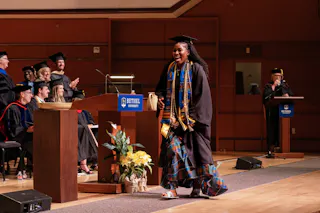
Celebrating Chan
Brushaber:
In addition, the university nomenclature sets us apart from the Bethel
Colleges of Mishawaka, Indiana; North Newton, Kansas; or McKenzie,
Tennessee. We have transitioned from a parochial, upper Midwestern
institution to a national institution in terms of enrollment, scope of
programs, physical presence, and recruitment and placement patterns. The seminary was the first to go that way with its
distance programs and teaching locations in three regions of the United
States. We anticipate that the college undergraduate program and
graduate programs will move in that same sense. And while we lead and
serve the Baptist General Conference, we also serve a broad evangelical
constituency representing many other denominations.
Eliason:
In fact I just learned that the number of denominations represented at
the seminary has risen from 41 last year to more than 50 now. So the
attractiveness of Bethel to the evangelical movement keeps growing. I
like to describe the educational process at Bethel Seminary as both
serving the movement and shaping it. The seminary’s capacity to
accommodate students anywhere in the world, as long as they have access
to a computer and can come to our campus twice a year for a couple of
weeks at a time, makes it a wonderful serving institution. But it
doesn’t really feel like an institution; it feels like we are part of
this movement of God.
H&M: What advantages or benefits might the students, faculty, or staff of Bethel Seminary enjoy as a result of Bethel’s university status?
Eliason: One highly significant advantage for Bethel’s growing number of international students becomes apparent when you consider our progress in developing global mission concentrations at both the D.Min. and M.Div. levels, and our plans to offer a master’s degree in global evangelism and contextualization. The anti-Christian bias is so strong in many parts of the world that students have trouble getting visas to come to Bethel Seminary. But a master’s degree in cultural anthropology, for example, granted by Bethel University, has a much better chance of global acceptance among other governments. So now we enjoy far greater flexibility in accomplishing our global mission impact.
And, too, there are many examples across the country where the university model has squeezed the seminary into a specific mold within its structure, very often limiting any opportunity to grow beyond that space. But the Bethel Board of Trustees and Bethel’s new governing structure have provided a place of flexibility and continued growth for Bethel Seminary. It’s a win-win situation. Our staff in San Diego talks about how pleased they are that we are part of Bethel University. Bethel Seminary of the East talks about it. Our alumni talk about it. There’s a sense of enhancement of Bethel Seminary’s home base.
"U" Rock
Brushaber: What we have here is a seminary whose integrity and stature are not compromised. Bethel Seminary still has its own executive vice president, provost, and executive director. The faculty still makes its own decisions about curriculum, not subject to review by graduate school faculty or college faculty or university-wide faculty. The academic integrity of the seminary is very much protected and respected, and I believe that’s quite different from some other institutions. We have chosen to move forward while also recognizing our seminary’s longstanding strength and vitality.
I want to add that as we publicize the national place of Bethel University, we attract a national student body that also benefits the seminary. San Diego and our East Coast branches are perceived as part of a larger whole. This is good news to our accrediting agencies and to those who support us financially. The institution here in the St. Paul area has tremendous resources in terms of faculty development, human resources, marketing, and more, all of which enhance the opportunities, satisfaction, and service to the Bethel community on either coast. There are tangible benefits to being part of the whole when the whole gets bigger.
Say Amen
For all of its 133 years of history, Bethel has been a dynamic educational institution, embracing growth, expanding programs and services, and reorganizing when necessary to better fulfill its mission. At least eight different names since our founding reflect this fact, including Swedish Baptist Theological Seminary, Swedish American Bible Seminary, Bethel Academy and Theological Seminary, Bethel Institute, Bethel Junior College and Seminary, and Bethel College & Seminary. Bethel University is the next step in a continuing tradition of dynamic growth and adaptability.
Story photographer: Tara Patty