


Alumni & Friends
A Magazine of Bethel University
By Holly Donato '78
Large
daily papers are struggling. Blogs are attracting readers to the
web. Is there a future for classic journalism? A resounding "yes" comes
from Phyllis Alsdurf, Ph.D., head of the Bachelor of Arts in Journalism
program at Bethel University.
"I'm a firm believer that people are always going to need reliable information," Alsdurf says. "I'm not convinced that bloggers are going to provide what people want in the way of carefully researched stories, and that's the kind of training and skills our journalism students are learning. People who are trained in foundational journalistic skills are going to be able to adapt to new technologies."

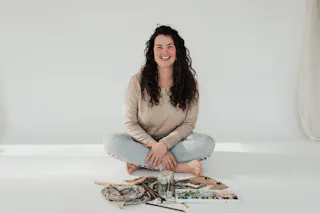
Phyllis Alsdurf, Ph.D., with her Advocacy
Journalism class.
Bethel's journalism major is just two years old, yet 25 students are enrolled in the well-rounded curriculum, designed to prepare solid Christian journalists for work in real newsrooms—print, broadcast, and web.
"Phyllis has gotten me interested in the field of journalism in ways I never would have dreamed possible," says senior Monique Champeau, who, like all journalism majors, uses Alsdurf's first name. "I fell in love with journalism after taking an interim course with her."
After basic principles in News Writing, Feature Writing, and Principles of Editing and Design, student journalists delve into a rich mix of upper-level courses such as Community Journalism, Advocacy Journalism, Critical Issues in Journalism, Media Communication, Media Law, Broadcast Writing, and Writing for the Web. While the major is based in the Department of English, courses such as Media Communications and Media Law draw on expertise in the Department of Communication Studies.
"The classes have expanded into all necessary areas of journalism," says senior Cory Streeter. "Phyllis Alsdurf has been nothing short of amazing with her leadership."
Throughout the program, students encounter issues especially relevant for the Christian reporter. "In the course Advocacy Journalism, we ask ‘Do we stand outside the story, are we objective, or do we advocate?'" says Alsdurf. "We look at the long history of muckracking, and then we look at contemporary settings. It provides an important historical foundation for understanding issues around objectivity."

From left to right: Bethel
students Nicolle Westlund,
Cory
Streeter,
Maria Sanny,
and Doug Ekbom visited the
New York Times.
Journalism students learn both theory and craft, many honing their skills in the "laboratory" of the weekly 10-page Clarion student newspaper. In addition, all are required to complete at least one off-campus internship. Students have worked for Lillie Suburban and Press Publications community newspapers; MSP Publications in the Twin Cities; a Rochester, Minn., magazine; Minnesota Timberwolves; and the Asian American Press in St. Paul. Answering to "real" editors on a deadline seasons these formative journalists, and gives them a portfolio and contacts to use in securing jobs after graduation.
"Phyllis is very good at tailoring the program to individual students' needs," says Champeau. "She's been instrumental in keeping her eyes open for bilingual presses and writing opportunities, since that's where my heart is. I look forward to plugging my interest in Spanish and my Christian worldview into practice in a changing field."
Clarion sports editor Maria Sanny is also an enthusiastic journalism major. "I have gained tremendous experience. My communication skills have transferred to other jobs I hold, such as in Student Senate," where she has to draft clearly worded bills.
"I'm very, very pleased with the quality of students who are majoring in journalism, and their commitment," says Alsdurf. "Working with them is just fun."
Working on Bethel's behalf, Alsdurf has made groundbreaking contributions to her field as it intersects with faith. Last fall, she organized and hosted "Journalism Through the Eyes of Faith," a national conference open to the media and public that explored issues of religion as they play into news coverage. As conference speakers, she brought such renowned journalists to campus as Bill McKibben; public radio's Krista Tippet, host of "Speaking of Faith;" and Naomi Schaefer Riley, a Wall Street Journal religion editor. Plans for another conference this fall are underway, with a tentative keynote commitment from Ray Suarez, senior correspondent with Jim Lehrer's "NewsHour" on PBS.
How does she attract such big-name journalists to Bethel? "I guess it's having the audacity to say ‘We're here, too,'" chuckles Alsdurf. "I have found people to be amazingly open and encouraging."
Alsdurf and her teaching colleague Scott Reed, who holds a master's in Christian thought from Bethel Seminary and worked for a dozen years at the Minneapolis Star Tribune, not only bring to class guest journalists such as Star Tribune religion writer Pam Miller, they also take students off campus to observe other media. "Journalism classes require a steady infusion from practicing journalists," Alsdurf insists. "It's important to have that contact."
Recently, several students visited the New York Times for a day of shadowing and discussing the news business with large-market reporters. A group also represented the Clarion at the Associated Collegiate Press [ACP] conference in Portland, Ore., where a former editor of a major daily sat down with the students and critiqued the Clarion.
"[ACP] gave us a very unique opportunity to see the role a paper can have within a student body, and how our paper lines up with those at colleges of similar sizes and backgrounds," says Champeau. "It was an eye-opener to see that we really do have a lot more power on our campus than students on many others, and I hope that as a result we will use it to move people here."
The media's power to influence makes it all the more vital for Bethel journalism graduates to cement the Christian values they take into their careers. In a capstone course, Critical Issues in Journalism, seniors write a paper examining the integration of their faith with their upcoming place in the "fourth branch of government," as the media are often called.
"Historically, the roots of journalism are evangelical—righting wrongs, [doing] justice, speaking truth to power," Alsdurf reasons. "I find that encouraging for a place like Bethel. We can provide something other schools can't."
Phyllis Alsdurf, director of the journalism program, holds a Ph.D. in mass communications (University of Minnesota) and master's degrees in humanities (Western Kentucky University) and journalism (Kansas State University). She edited a Christian family magazine, co-authored a book, wrote for numerous magazines in the religious market, and served as director of publications in the Office of Communications and Marketing at Bethel before becoming an assistant professor of English and head of the journalism program. Alsdurf's doctoral dissertation was an examination of Christianity Today magazine.

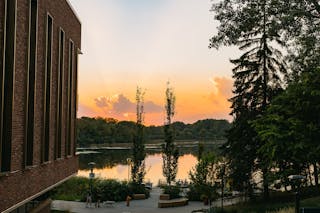
photo courtesy of
Chris Tompkins
To photojournalism student Chris Tompkins, who aspires to a career with National Geographic, Bethel's "Journalism Through the Eyes of Faith" conference last fall was both "a pinnacle moment in Christian journalism" and also a personal "blessing." He collared the nationally known guest editors one-on-one and pressed them for input over lunch. This fearlessness is typical of Tompkins, whose stunning outdoor photography has already been published in Minnesota Trails magazine and earned him email conversations with his favorite National Geographic photographers.
Tompkins has been accepted into three top graduate programs in journalism, including the University of California Berkeley, where one in 25 applicants is accepted. To catch Berkeley's eye, he traveled around rural Minnesota for three months last summer, tenting in fields and capturing rare moments, from Sioux ceremonies and Lake Superior kayaking to Northwest Angle sunrises. He researched the background of each scene, and distilled the stories into vivid one-paragraph vignettes.
"I got a great foundation in writing [from Bethel's journalism program]," says Tompkins, "—how to communicate the story more effectively and efficiently." Using skills learned from college-level computer classes he'd taken in junior high, Tompkins created an online photo essay, "Land and People: The Outdoor Life of Minnesota," which he uploaded as a website accompanying his Berkeley application.
"Journalists are going to have to be photographers, writers, and programmers in order to create a quality product and proliferate it into the media," he contends. "I came to Bethel because of the passion [English professors] Barrett Fisher, Dan Ritchie, and Phyllis Alsdurf have for their students. I wouldn't have done this kind of work at a top-tier secular school. I can't imagine being as motivated without those people believing in me."