


Experience Bethel for yourself
Visiting campus is the best way to learn about Bethel and our majors. As you explore our welcoming community, you can attend a class, meet with students and professors, and get a taste of life in our program.
Meaningful preparation
Program highlights
All our academic departments stand out for their excellence and innovation—and the way our professors care about their students. Learn more about what sets our department apart.
Learning opportunities
As a speech-language pathology major, you’ll have opportunities to connect classroom learning with real-world experience:
- Shadow professionals in speech-language pathology. Observe clinicians in professional settings and gain a firsthand understanding of speech-language pathology careers.
- Participate in clinical practicum experiences. Begin developing clinical reasoning and communication skills through supervised experiences with clients.
- Engage in research with faculty mentors. Collaborate with faculty as you explore questions and emerging practices in speech-language pathology.
- Explore communication sciences and disorders through hands-on coursework. Study areas such as anatomy and physiology of speech and swallowing, neuroanatomy and neurophysiology, speech and language development and disorders, and evidence-based care.
Preparation for graduate study
Bethel’s speech-language pathology curriculum provides a strong foundation for graduate study, with an accelerated pathway that allows qualifying students to begin integrating graduate coursework during their undergraduate studies. Students who want to become licensed speech-language pathologists can continue into Bethel’s Master of Science in Speech-Language Pathology (MS-SLP) program, creating a connected path from undergraduate preparation to advanced professional study.
Career readiness
With a speech-language pathology degree, you'll have the knowledge, skills, and experience to provide high-quality clinical services. You can work as an SLP assistant in schools or healthcare settings by obtaining a state license, or continue on to a master’s program to become a licensed speech-language pathologist. To practice independently as a licensed speech-language pathologist, you’ll need graduate-level education and must meet the professional licensure requirements of the state where you practice.
Faith integration
You’ll study communication sciences and disorders through a Christ-centered lens that connects faith with ethical, patient-centered care. As you prepare to serve children, aging adults, individuals with disabilities, people recovering from stroke or living with aphasia, and others with communication or swallowing disorders, you’ll learn to recognize the dignity and value of every person.
Real-world impact
Career outcomes
A bachelor's degree in speech-language pathology is a strong pre-professional pathway for students interested in speech-language pathology, audiology, communication sciences and disorders, and related healthcare and education fields. The BS-SLP major prepares you for graduate education as well as career settings where knowledge of communication disorders, accessibility, and human development is valued. Students who want to become licensed speech-language pathologists will continue into graduate study, while others may pursue related roles in healthcare, education, research, advocacy, and early intervention.
Skills
You’ll learn to:
- Communicate effectively in clinical and professional settings
- Apply critical thinking and clinical reasoning skills
- Understand speech, language, hearing, cognitive, and swallowing development and disorders
- Connect anatomy, physiology, and neuroscience to communication and swallowing
- Work effectively with individuals from diverse backgrounds and across the lifespan
- Apply evidence-based approaches to assessment and treatment planning
- Approach healthcare decisions with cultural awareness and ethical judgment
- Translate classroom learning into clinical and professional setting
Careers
Your speech-language pathology degree can prepare you to pursue paths such as:
- Speech-language pathologist—with graduate study and professional licensure
- Audiologist—with additional graduate study and professional licensure
- Speech-language pathology assistant (SLPA)—with additional state-specific requirements
- Early intervention and special education support roles
- Research and academic settings
- Healthcare administration
- Disability and communication advocacy
Graduate school
You can go on to study:
- Speech-language pathology
- Audiology
- Special education
- Public health
- Occupational therapy or physical therapy
- Neuroscience or psychology
Recent news
Different paths, shared purpose: Bethel celebrates spring commencement
Across Bethel’s undergraduate, graduate, and Seminary programs, commencement speakers challenged graduates to steward their education, faith, and calling in service of others.
June 05, 2026 | 9 a.m.

Upcoming events
OCT 30 2026
Bethel University Fall Preview Days
8:15 a.m. | CLC Lobby
Preview Day offers an inside look at campus life through tours, chapel, faculty connections and more.
NOV 15 2026
6:30 p.m. | CLC Lobby
You've got the acceptance, now get the full Bethel experience at the Royal Retreat!
NOV 17 2026
6:30 p.m. | Online
Explore our undergraduate art programs and connect with department faculty during this live virtual information session.
NOV 19 2026
6:30 p.m. | Online
Parents of prospective Bethel students are invited to join us for a webinar focused on learning more about Financial Aid at Bethel.
Contact us
Request info
Interested in learning more about Bethel's speech-language pathology program? Fill out this simple form and we'll send you more information soon.
Connect with a counselor
They’ll answer your questions, connect you with professors, and help you find the right time to visit campus. They’ll be there every step of the way to help make applying to Bethel as smooth as possible.
Faculty mentors
Meet your professors
You’ll learn alongside professors who are accessible and usually have an open-door policy so you can stop by with questions.


Student Support
Your support team
At Bethel, you’ll experience a community where you belong. And that means you’ll be able to access numerous tools for your academic success—tutoring, mentors, study help, and more.
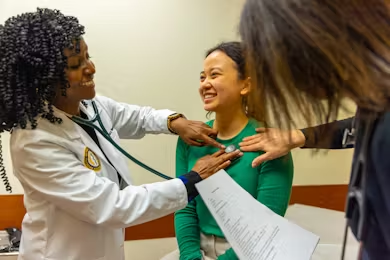
Career coaching and preparation
A dedicated team is here to empower you to lead a purposeful life. Career coaches will help you build a resume, pursue internships and jobs, and provide support every step of the way.

Academic advising
No matter your goals, you’ll find support from your advisor. They’ll help you plan your courses and will provide support as you complete your degree and start a successful career.
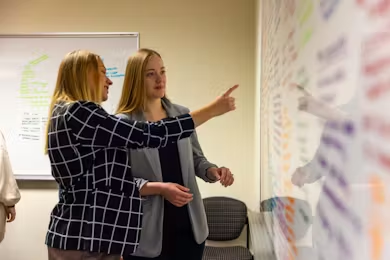
Tutoring and academic support
The Academic Enrichment and Support Center (AESC) will be your first stop for academic support. You’ll find help in building study skills, academic counseling, and more.
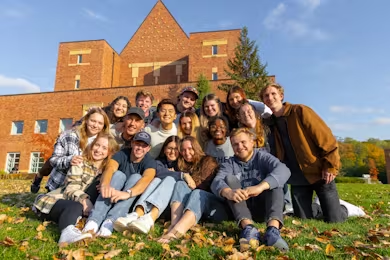
Faith formation
As you develop your faith, you’ll have support from our Campus Ministries team. From Chapel to Bible studies, you’ll have numerous opportunities to explore and grow in your faith.

A path with promise
Clear price. Clear outcomes.
Know what your education costs—and where it’s taking you. You’ll start with a clear price so you can focus on what truly matters: your education and your future. And you’ll graduate with confidence through the Bethel Career Commitment, which includes built-in career coaching and additional support for eligible graduates who still need help.

Become A Bethel Student
Apply now
You belong at Bethel. If you're ready to see who you could become, start your free application today.
Frequently asked questions
- An undergraduate speech-language pathology major is a pre-professional program focused on communication sciences and disorders. Bethel’s Bachelor of Science in Speech-Language Pathology (BS-SLP) introduces you to areas including speech, language, hearing, cognition, and swallowing and prepares you for graduate study or related careers in healthcare, education, research, and advocacy.
-
Communication sciences and disorders is the broader academic field that examines speech, language, hearing, cognition, and swallowing. Speech-language pathology is a profession within that field focused on evaluating and treating communication and swallowing disorders. An undergraduate communication sciences and disorders major or speech-language pathology degree commonly serves as preparation for graduate education in speech-language pathology.
-
Bethel’s BS-SLP program includes coursework in areas such as:
- SLP 200: Anatomy and Physiology of the Speech and Swallowing Mechanisms
- SLP 201: Introduction to Audiology
- SLP 202: Introduction to Phonetics
- SLP 204: Introduction to Communication Disorders
- SLP 300: Neuroanatomy and Neurophysiology for Communication and Swallowing
-
Hands-on learning is built into Bethel’s speech-language pathology major. You’ll have opportunities to shadow speech-language pathology professionals, participate in supervised clinical practicum experiences, apply concepts through laboratory and coursework experiences, and engage in faculty-guided research.
These experiences help you connect theory with practice while developing the clinical reasoning and professional skills you’ll need for graduate study and future speech-language pathology careers.
-
Yes. Becoming a licensed speech-language pathologist requires graduate-level education in speech-language pathology as well as meeting state-specific professional licensure requirements.
Bethel’s undergraduate BS-SLP program is designed as preparation for that next step. After completing your bachelor’s degree, you can pursue a Master of Science in Speech-Language Pathology at Bethel or another graduate institution.
-
Yes. Bethel offers both a Bachelor of Science in Speech-Language Pathology and a Master of Science in Speech-Language Pathology, giving students the opportunity to continue from undergraduate preparation into graduate professional study at Bethel.
The undergraduate program also provides opportunities for qualifying students to integrate graduate-level coursework into their undergraduate studies as they prepare to pursue an MS-SLP.
-
Bethel University is institutionally accredited by the Higher Learning Commission.
Specialized CAA accreditation applies to graduate programs in speech-language pathology rather than undergraduate BS-SLP programs. Bethel’s Master of Science in Speech-Language Pathology is currently a Candidate for Accreditation through the Council on Academic Accreditation in Audiology and Speech-Language Pathology (CAA) of ASHA.
-
Candidate for Accreditation is a formal preaccreditation status granted by the Council on Academic Accreditation in Audiology and Speech-Language Pathology to developing or emerging graduate programs.
Bethel’s MS-SLP was awarded candidacy in 2026. Students who graduate from a program with CAA candidacy status may pursue ASHA certification provided they meet ASHA’s applicable academic, clinical, examination, and other certification requirements.
-
A bachelor’s degree in speech-language pathology most commonly prepares students for graduate study in speech-language pathology or audiology. It can also provide a foundation for careers and further study in areas such as early intervention, special education, research, healthcare administration, advocacy, public health, and related fields.
Some graduates may also pursue work as speech-language pathology assistants. SLPA education and licensure requirements vary by state, so additional coursework, certification, supervised fieldwork, or licensure may be required after completing your bachelor’s degree.
-
At Bethel, your study of communication sciences and disorders is grounded in a Christ-centered understanding of the dignity and value of every person.
You’ll connect your faith with ethical, evidence-based, patient-centered care as you prepare to serve people across the lifespan—including children, aging adults, individuals with disabilities, and people living with speech, language, cognitive, or swallowing disorders. You’ll be challenged to combine professional excellence with compassion and a commitment to helping every person communicate and participate more fully.