


Become who you’re meant to be. While earning a B.S. in Physics, you’ll receive a rigorous education designed to strengthen your analytical thinking, critical reasoning, and experimental research skills. Our undergraduate physics program prepares you for graduate study, engineering pathways, medical physics, and other research-driven careers. The B.S. in Physics is the more intensive option if you plan to pursue graduate school or a career in scientific research. The B.A. in Physics requires fewer courses and allows more flexibility to personalize your education through a second major or minors.


Contact us
Request info
Interested in learning more about Bethel's B.S. in Physics program? Fill out this simple form and we'll send you more information soon.
Hey! Looks like the form didn't load. If it doesn't load after a second or two, please refresh the page and you should see it. If that doesn't work, please let us know.
Connect with a counselor
They’ll answer your questions, connect you with professors, and help you find the right time to visit campus. They’ll be there every step of the way to help make applying to Bethel as smooth as possible.
Courses and skills
What skills will I develop?
Throughout the B.S. in Physics program, you’ll build the advanced knowledge and technical abilities needed for graduate school, research careers, and pre-professional pathways.

Advanced research skills
Gain hands-on experience conducting independent research, including experimental design, data collection, and interpretation—essential preparation for graduate research and scientific careers.
Mathematical and computational modeling
Develop advanced mathematical and computational techniques for modeling complex physical systems used in engineering, data analysis, and scientific research.
Critical thinking
Develop advanced critical thinking and problem-solving skills, enabling you to tackle complex scientific challenges with creativity and innovation.
Communication skills
Learn to clearly communicate complex concepts through technical writing, presentations, and visual data, preparing you for graduate-level coursework and collaborative research environments.
Interdisciplinary perspective
Explore connections between physics and fields such as engineering, computing, and healthcare—broadening your opportunities for pre-professional preparation and interdisciplinary careers.

Academic plans
Map out your time at Bethel—from day one to your diploma. Your course schedule is designed to help you grow, gain skills, and become who you’re meant to be.
Learning opportunities
What experiences will I have?
As a student in the B.S. in Physics program, you’ll engage in hands-on learning experiences that strengthen your preparation for graduate school, research careers, and technical professions.

Hands-on research
You’ll have the opportunity to participate in nationally competitive research internships at prestigious institutions for academic credit or to earn income. You’ll also help publish papers and present findings at local and national conferences.
Research with faculty
In addition to completing a two-course faculty-led research sequence, you can apply to work full time for 10 weeks in Bethel’s labs through funded research opportunities supported by NASA and NSF grants.

State-of-the-art research labs
You’ll have access to 15 research labs covering roughly 12,000 square feet of space. Many of these upper-level labs use equipment similar to what you’ll encounter in industry and graduate research facilities.
Real-world impact
What can I do with a physics degree?
A B.S. in Physics opens the door to a wide range of careers and advanced educational opportunities. Graduates of Bethel’s physics program pursue graduate school, engineering careers, research roles, and specialized professional pathways.
Graduate school
Pursue advanced degrees in physics, astronomy, engineering, mathematics, or related fields, preparing for careers in academia, research, or industry.
Research
Conduct cutting-edge research in academia, government laboratories, or private industry, contributing to advancements in knowledge and technology.
Data analysis
Analyze complex datasets to extract meaningful insights and inform decision-making processes in fields such as finance, healthcare, or environmental science.
Engineering
Apply your advanced physics knowledge to pursue careers in various engineering fields, such as aerospace engineering, materials science, or renewable energy.
Medical physics
Specialize in medical physics, developing new diagnostic and therapeutic techniques to improve patient care and treatment outcomes.
Technology development
Work in research and development roles in technology companies, contributing to the development of new technologies and innovations.

Start your journey
Explore Bethel for yourself
Visiting campus is the best way to learn about Bethel and our majors. As you try out academic and campus life at Bethel, you can attend a class, chat with students, meet professors and coaches, tour campus, and get a taste of life in our program.
Faculty mentors
Meet your professors
You’ll learn alongside faculty who are distinguished scholars and faithful Christians. They’ll know you by name and invest in your success.








Student Support
Your support team
At Bethel, you’ll experience a community where you belong. And that means you’ll be able to access numerous tools for your academic success—tutoring, mentors, study help, and more.

Career coaching and preparation
A dedicated team is here to empower you to lead a purposeful life. Career coaches will help you build a resume, pursue internships and jobs, and provide support every step of the way.

Academic advising
No matter your goals, you’ll find support from your advisor. They’ll help you plan your courses and will provide support as you complete your degree and start a successful career.
Tutoring and academic support
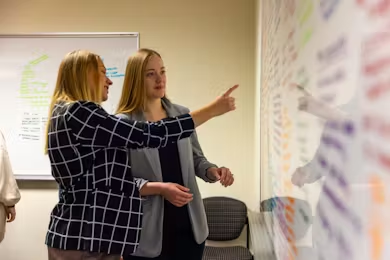
The Academic Enrichment and Support Center (AESC) will be your first stop for academic support. You’ll find help in building study skills, academic counseling, and more.
Faith formation
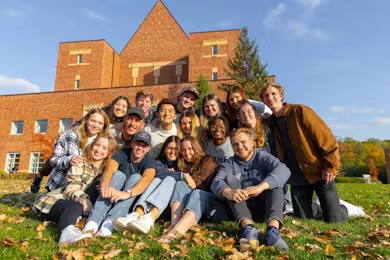
As you develop your faith, you’ll have support from our Campus Ministries team. From Chapel to Bible studies, you’ll have numerous opportunities to explore and grow in your faith.

A path with promise
Clear price. Clear outcomes.
Know what your education costs—and where it’s taking you. You’ll start with a clear price so you can focus on what truly matters: your education and your future. And you’ll graduate with confidence through the Bethel Career Commitment, which includes built-in career coaching and additional support for eligible graduates who still need help.

Become A Bethel Student
Apply now
You belong at Bethel. If you're ready to see who you could become, start your free application today.
Find your fit
Explore related programs
Bethel’s small size, strong community, and liberal arts focus allows you to personalize your education by adding additional majors or minors. In fact, about 30% of students double major—and many pursue degrees in vastly different disciplines.


Explore the full lists:
Frequently Asked Questions
-
An undergraduate physics major introduces students to the fundamental laws that govern matter, energy, motion, and the structure of the universe. In a bachelor’s degree in physics program, students study topics like classical mechanics, electromagnetism, thermodynamics, quantum physics, and mathematical modeling while also gaining hands-on experience through laboratory experiments and research projects. At Bethel, physics majors also work closely with faculty mentors and apply their learning in real-world contexts through research and collaborative problem-solving.
-
Both the B.A. in Physics and B.S. in Physics provide a strong foundation in physics, mathematics, and scientific reasoning, but they are designed for different goals. The Bachelor of Science (B.S.) in Physics includes more advanced physics and math coursework and is often chosen by students planning to pursue graduate school or research careers in physics or engineering. The Bachelor of Arts (B.A.) in Physics offers greater flexibility, allowing students to pair physics with another major or minor—such as mathematics, computer science, or pre-health studies—while preparing for a wide range of interdisciplinary or pre-professional career paths.
-
A physics bachelor’s degree opens the door to many careers that value strong analytical and quantitative skills. Graduates often pursue roles in engineering, technology development, data analysis, research, and scientific consulting, while others continue their education through graduate programs in physics, engineering, astronomy, or applied science. Some students also pursue specialized fields such as medical physics or healthcare technology. Bethel’s physics program combines rigorous academics with career preparation to help students confidently transition into professional roles or advanced study. Learn more about career preparation and outcomes at Bethel.
-
Yes. Physics is widely considered one of the best majors for students who enjoy problem-solving, analytical thinking, and scientific research. Physics students learn how to break down complex problems, develop mathematical models, and test ideas through experimentation—skills that are valuable across many industries and graduate programs. An undergraduate physics degree builds intellectual curiosity and resilience while preparing students to work on challenging problems in science, technology, engineering, healthcare, and beyond.
-
Students in a bachelor’s degree in physics program develop a wide range of transferable skills, including advanced problem-solving, quantitative analysis, computational modeling, experimental design, and scientific communication. They also learn how to work collaboratively on research projects and present technical information clearly through written reports and presentations. These skills prepare graduates not only for graduate school and research careers, but also for fields such as data science, engineering, and technology innovation.
-
Bethel’s faith-based physics program encourages students to explore scientific discovery within the context of a Christian worldview. Students engage with questions about the relationship between faith and science while studying the laws and patterns that shape the universe. Through mentorship from faculty who are both active scholars and committed Christians, students learn how their scientific work can serve others and contribute to meaningful solutions in research, healthcare, technology, and engineering.
-
Yes. A physics bachelor’s degree provides strong preparation for graduate school, engineering programs, and medical or health-related professional schools. The rigorous coursework in physics and mathematics builds the analytical foundation required for advanced study, while research experiences and faculty mentorship help students develop competitive graduate school applications. Many students also pursue interdisciplinary pathways—such as combining physics with pre-med or engineering interests—before continuing on to graduate or professional programs.
-
Graduates of an undergraduate physics program pursue a wide variety of careers across science, technology, and industry. Common paths include engineering, scientific research, data science, technology development, aerospace, renewable energy, and healthcare-related fields such as medical physics. Because physics graduates develop strong analytical and technical skills, they are also well prepared for roles in consulting, finance, software development, and other data-driven professions. Bethel students benefit from career coaching and internship opportunities through The Studio for Vocation and Calling and the Bethel Career Commitment.
